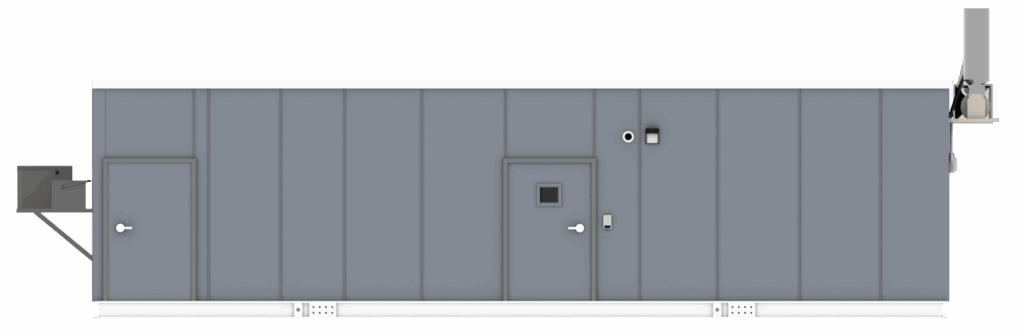
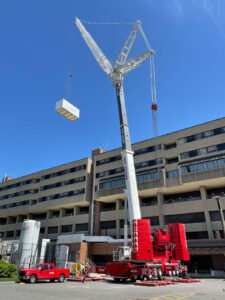
 Modular Design Began as a Solution to Access Challenges
Modular design did not begin as an efficiency trend or a construction shortcut. It emerged from necessity. In the mid-1800s, during the California Gold Rush, populations expanded into remote regions faster than traditional infrastructure could support. Housing shortages threatened economic opportunity, safety, and growth, yet conventional construction methods were too slow and dependent on permanent infrastructure and supply chains that had not yet been established. Modular construction solved this problem by shifting fabrication offsite and transporting finished structures to where they were urgently needed.
At its core, modular construction was about access. It enabled people to live and work in places that would otherwise have been unreachable. That same principle—bringing critical infrastructure to the point of need—has remained central to modular constriction ever since. Today, modular cleanrooms, mobile cleanrooms, mobile imaging, and modular imaging solutions are direct descendants of that original idea, designed to deliver advanced clinical and manufacturing capabilities quickly, reliably, and exactly where they are needed most.
From Early Modular Buildings to Mobile Infrastructure
As modular construction matured, it continued to evolve in response to access-driven challenges. In the late 1800s and early 1900s, the military adopted modular construction to support service members stationed in remote or rapidly changing locations. These modular structures provided consistent, repeatable environments where permanent infrastructure could not be built quickly enough.
By the 1920s, modular design expanded beyond residential use into industrial applications, supporting more complex operational needs. After World War II, modular construction once again addressed a national access issue as rapid housing development became essential. Prefabricated catalog homes allowed families to move into permanent residences without long construction delays.
Across each of these areas, modular construction succeeded because it consistently delivered:
- Speed of deployment
- Repeatability and consistency
- Access to critical capabilities in constrained environments.
These same drivers now underpin mobile imaging units, modular imaging facilities, and mobile and modular cleanrooms used across modern healthcare and life science industries.
The Shift from Temporary Structures to Permanent Modular Solutions
Despite its effectiveness, modular construction was often perceived as temporary through much of the mid-20th century. Schools, hospitals, and offices built using modular techniques in the 1960s were frequently viewed as interim solutions rather than long-term assets. That perception shifted in the 1980s as advances in construction materials, engineering, and quality standards transformed modular buildings into permanent commercial structures.
Modern commercial modular construction is no longer about containers or short-lived facilities. These buildings are engineered to meet the same codes, specifications, and durability expectations as traditional construction, with no inherent lifespan limitations when properly maintained. This evolution enabled modular construction to move confidently into regulated healthcare environments.
From this foundation emerged modular cleanrooms for pharmaceutical compounding and manufacturing, as well as modular imaging facilities designed to house advanced diagnostic equipment. Mobile cleanrooms and imaging solutions extended these capabilities even further, allowing for critical infrastructure to be deployed rapidly and relocated as patient demand shifts.
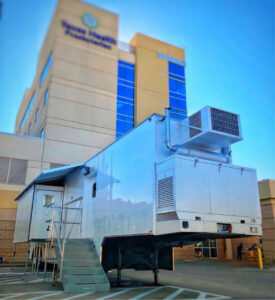 Modern Healthcare Innovation Faces a Familiar Access Problem
Today’s healthcare systems face a challenge that closely mirrors the conditions that gave rise to modular design in the 1800s. Innovation, particularly in diagnostics, imaging, pharmaceuticals, and advanced therapies, is scaling than physical infrastructure can keep up. Traditional construction timelines, site constraints, and capital requirements slow access to care, even when technology is readily available.
This is especially evident in imaging and radiopharmaceutical workflows. Advanced diagnostics are often a gateway to treatment, yet imaging capacity is frequently constrained by space and infrastructure, as well as budget and funding limitations and competing capital funding needs. Similarly, radiopharmaceutical manufacturing requires proximity, speed, and reliability—conditions that traditional centralized facilities struggle to meet.
Access is not only about geography; it is also about speed and resilience. In modern healthcare systems, access can disappear overnight when infrastructure fails, construction projects stall, or critical systems are taken offline. Imaging suites may be unavailable due to equipment upgrades, facility renovations, or unexpected downtime, yet patient demand does not pause. In these moments, mobile imaging and mobile cath solutions become essential infrastructure, restoring diagnostic and interventional capability when permanent systems cannot. They allow healthcare systems to maintain continuity of care, support surge capacity, and validate new technologies without waiting months or years for construction to catch up.
Similarly, the speed at which science and technology advancements are made does not easily align with the rigidity and limitations traditionally constructed infrastructure places on progress. As personalized medicine and point-of-care delivery gain traction, the workflows, quality systems, space and segregation required to administer care to patients in those modalities do not typically exist in existing healthcare facility design, even those that are less than a decade old.
Once again, access—not innovation—is the limiting factor.
How Mobile and Modular Cleanrooms and Imaging Labs Bridge the Gap
Mobile cleanrooms, modular cleanrooms, and mobile and modular cath and imaging labs all apply the original principles of modular design to modern healthcare delivery. These environments are fabricated, tested, and commissioned offsite under controlled conditions, ensuring consistent quality, performance, and compliance before they ever reach as site. Once deployed, they are ready for operation with minimal disruption to existing clinical workflows.
Together, these solutions allow healthcare systems to:
- Expand diagnostic and manufacturing capacity quickly
- Bring imaging and production closer the patients
- Reduce downtime and operational risk
- Scale services without the long-term infrastructure constraints
- Avoid the capital approval process and quickly deliver solutions under an affordable operating lease/rental program
Mobile imaging units deliver immediate diagnostic access in locations where permanent imaging suits are not feasible. Modular imaging facilities provide short- and long-term, high-performance diagnostic and interventional environments without the delays of traditional construction. Modular and mobile cleanrooms enable point-of-care pharmaceutical compounding and manufacturing, shortening the distance between production and treatment.
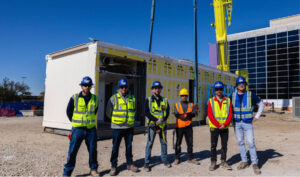
A Unified Portfolio Built around Access
Viewed together, mobile and modular imaging labs and cleanrooms form a single, integrated strategy: delivering care, diagnostics, and innovation wherever patients are. This is the modern expression of a 175-year-old idea: that infrastructure should adapt to need, not the other way around.
Just as
modular buildings once brough housing to underserved regions, today’s mobile and modular healthcare solutions bring diagnostics, treatment, and manufacturing directly to clinicians and patients. They overcome barriers of time, distance, and infrastructure to expand access across the continuum of care.
For Modular Devices, the portfolio reflects not just a set of solutions, but a philosophy rooted in access by design.