Being headquartered in Indianapolis, the Indy 500 is near and dear to the team’s hearts. Anyone who has attended a race understands that the atmosphere is electric, the sensation of the cars speeding by is jarring, and the sounds are overwhelming. Yet, one of the most intriguing aspects happens slightly off the racetrack…in the pit. 
At the Indianapolis 500, a car enters the pit at more than 200 miles per hour. For context, that is roughly the takeoff speed of a 737.
Then, in less than seven seconds, the put crew changes tires, refuels the car, makes critical adjustments, and sends the car back out without losing competitive position.
Now, compare that to performing the same work in a typical garage where a routine oil change can sometimes turn into an overnight stay at the shop.
The difference is not simply speed. It is systems and processes.
Every movement in that put stop is scripted. Every role is defined. Every process is rehearsed, standardized, and compliant with race regulations. There is no improvisation because, at that level, improvisation introduces risk.
Most importantly, the team is not just fast once. The crew is fast every time—under pressure, at scale, and without margin for error.
In that environment, a two-second delay is not merely inconvenient; it is the difference between winning and falling out of contention. This year’s race was won by .0233 seconds!
While radiopharmaceutical facilities may not measure performance in fractions of a second, isotope half-lives are measured in minutes, and that urgency carries over into facility builds. That pit crew mentality is the kind of performance expected from the design and delivery of critical infrastructure.
Rather than relying on slower, custom, one-off builds that depend on perfect conditions, the industry is shifting toward repeatable, scalable systems designed for speed, built for compliance, and engineered to reduce cost and eliminate risk.
The checkered flag may be different, but the race is very real. It is a race against time to deliver critical care, and a race against competitors to bring lifesaving therapies to market. Modular construction is proving to be a vital and viable tool for optimizing speed, compliance, patient access, and ultimately revenue.
Depending on the source, the CAGR for the radiopharm industry is projected between 7.5% and 11% annually over the next decade. Even at the lower end of those projections, the market is expected to more than double, with estimated growth ranging from $12–22 billion. That kind of rapid expansion will place significant strain on infrastructure that is already struggling to keep pace.
Facility builds—even retrofits of existing sites—currently average 12–24 months, and that timeline typically begins only after months of planning and engineering have already been completed.
When compounded with the compliance burden associated with permitting, building, commissioning, and validating a cGMP radiopharmaceutical facility, the industry will need solutions that increase speed, maintain quality and compliance, and minimize risk.
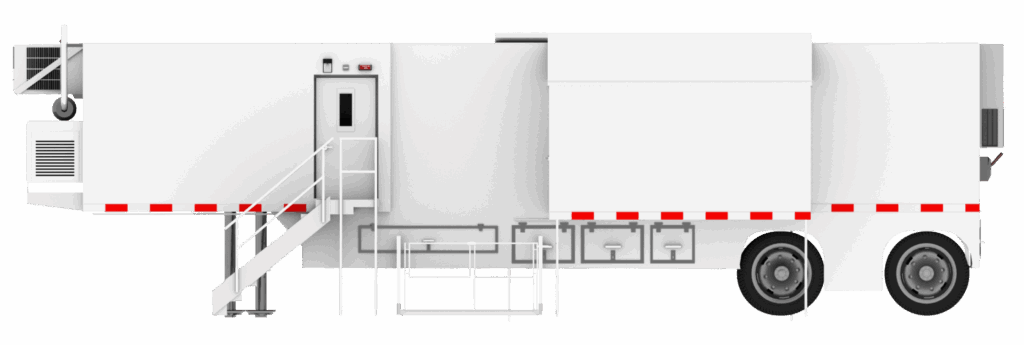
This is where modular construction—both commercial modular construction and panel-based modular cleanrooms—can provide significant advantages. Below are five key value drivers.
Accelerated Time to Production
Modular construction accelerates timelines by enabling parallel path construction. Whether retrofitting an existing facility or executing a greenfield build, upfront activities such as demolition, site preparation, shell buildout, and utility installation must be completed before core infrastructure like cleanrooms can progress.
Because modular infrastructure is fabricated off-site in centralized facilities, infrastructure construction effectively begins on day one—sometimes even before ground is officially broken.
Once site preparation is complete, teams install critical infrastructure components rather than beginning the next phase of an on-site construction project from scratch.
On average, this results in a 30–50% reduction in construction timelines, or approximately 3–6 months faster than traditional buildouts. In some cases, acceleration has reduced time to occupancy by more than 18 months.
Accelerated cGMP Compliance and Validation
Completing construction is only one hurdle on the path to production readiness. Ensuring compliance through commissioning, qualification, and validation (CQV) is the next critical step. 
Modular construction introduces predictability and reliability into this process. Factory-controlled production environments dedicated to controlled environments, combined with standardized construction materials and fabrication methods, create clearer CQV pathways compared to traditional stick-built construction.
Traditional construction often depends heavily on tradespeople moving between projects and working in environments that vary significantly in form and function.
Prefabricated cleanroom panels are engineered specifically for performance and compliance. In the case of commercial modular construction, units can be fully assembled and pre-validated at the factory, with guaranteed performance upon installation.
This proactive approach to compliance enables CQV activities to begin faster than with traditional construction methods. On average, these activities can be completed 10–30% more quickly, with fewer deviations and less rework.
Increased Standardization and Scalability
Alongside the growth of the radiopharm market comes increased strain on isotope supply chains and the growing need to move production closer to patients.
For those familiar with radiopharmaceuticals, even an hour can exceed the half-life of many radioisotopes used in the industry. The often-referenced “melting ice cube” challenge limits delivery capabilities by geography.
Currently, only a limited number of cities possess the regulatory environment, geographic proximity, production infrastructure, workforce, and logistics capabilities needed to support today’s radiopharm production requirements.
The ability to scale distributed manufacturing and point-of-care production will be critical for industry growth.
Modular construction enables manufacturers and clinicians to achieve standardized scale. One major challenge is site selection, since finding nearly identical facilities in multiple cities is highly unlikely.
By pre-designing a commercial modular facility that integrates seamlessly with process workflows—and constructing those facilities under identical conditions, specifications, and production environments—a repeatable facility platform can be established for multi-site deployment.
From site to site, this approach can reduce design time by an average of 40–60%.
Additionally, the portability and mobility of pre-built modules make point-of-care centers increasingly viable for clinicians compounding isotopes used in detection, diagnosis, and treatment.
Enhanced Workflow Throughput and Optimization
Site selection challenges also create workflow limitations. Fitting a process into an existing space, rather than designing the space around the process, almost always requires compromises in form and functionality. 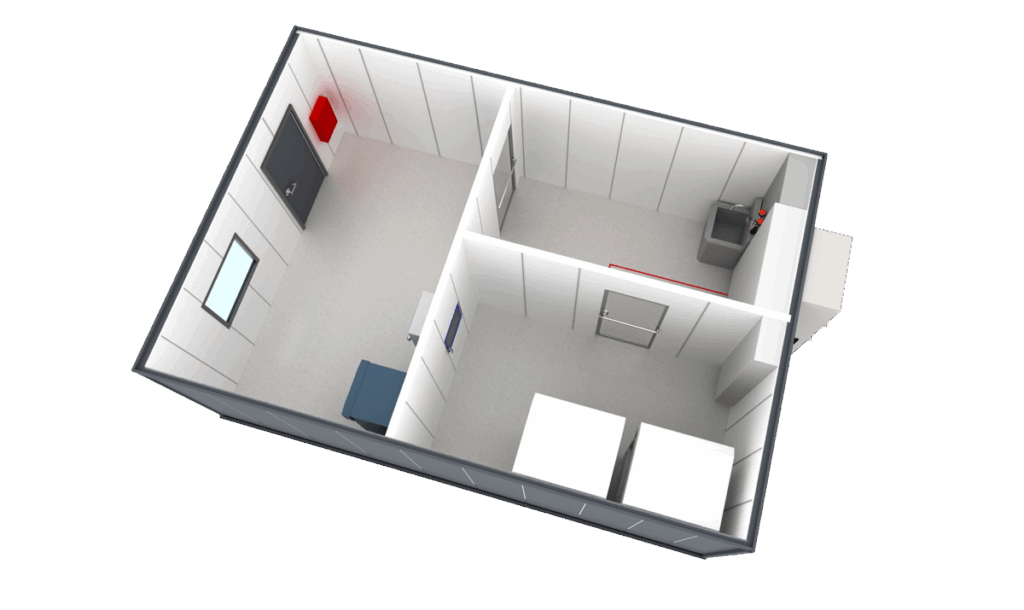
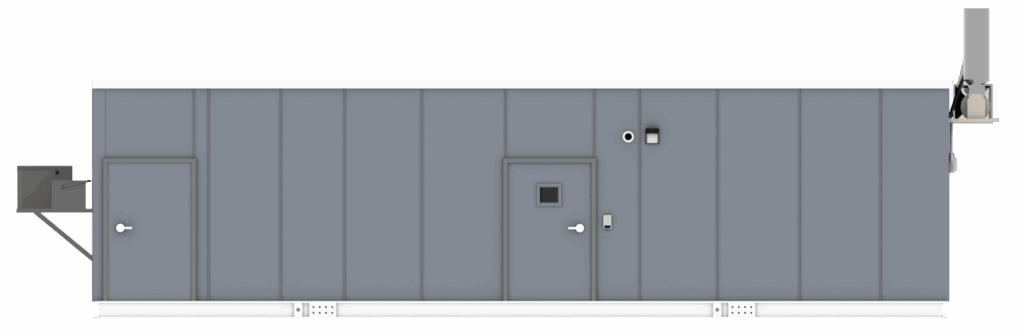
Commercial modular construction changes that dynamic by enabling site-agnostic facility design.
This approach allows facility layouts to be built around process requirements, ensuring personnel flows, material flows, waste flows, storage, utilities, and other critical design elements are optimized rather than constrained by existing infrastructure.
As a result, workflow becomes more efficient, movement and contamination risks are reduced, and quality control processes are strengthened.
Process-driven modular layouts routinely achieve throughput improvements of 10–25%.
Reduction in Risk
Every project carries inherent risks, and project teams are responsible for minimizing and mitigating those risks wherever possible.
While many risk-reduction benefits of modular construction have already been discussed, several deserve additional emphasis.
One of the costliest project risks is schedule extension. Delays not only increase project costs but also postpone revenue generation from production.
Traditional construction is highly vulnerable to weather disruptions. For example, in 1997 the Pacific Northwest experienced 79 consecutive days of rain—potentially resulting in two and a half months of schedule delays.
Off-site fabrication in controlled factory environments minimizes the impact of weather on construction progress, reducing variability in schedule, cost, and performance. Outdoor commercial modular construction amplifies these advantages because both the shell and core are built in controlled conditions.
Modular projects also experience fewer change orders on average because the structure is designed specifically to meet operational requirements, rather than forcing those requirements into existing structural limitations.
Additionally, performing the majority of heavy construction off-site reduces the duration and intensity of on-site work, lowering the risks of physical injury and property damage commonly associated with active construction sites.
The Impact
Like the performance of the pit crew mentioned earlier, speed combined with effective, compliant, and repeatable execution maximizes the likelihood of success.
In radiopharmaceutical manufacturing, success means delivering lifesaving therapies to patients faster while gaining competitive advantages in speed to market and profitable growth.
Based on industry benchmarks, accelerating a project by four months can create approximately $3 million in monthly value—or roughly $12 million in aggregate organizational impact.
Projects leveraging modular construction have reduced timelines by as much as 18 months.
That represents an additional year and a half of serving patients, providing hope, and improving both the quantity and quality of life.
Ready to Start Your Engines?
Ready to accelerate radiopharmaceutical production and reduce project risk? Modular Devices delivers turnkey modular cleanrooms designed to speed deployment, simplify compliance, and support scalable point-of-care production. Learn how modular infrastructure can help bring critical therapies to patients faster by connecting with the team at Modular Devices.