Why Radiopharmaceutical Cleanrooms are Different?
The design and construction of cleanrooms for radiopharmaceutical manufacturing is uniquely challenging, as it requires balancing two critical objectives: maintaining aseptic conditions and ensuring personnel safety from highly potent or radioactive compounds. Central to achieving this balance is understanding how Occupational Exposure Banding (OEB) influences every stage of cleanroom construction.
What is OEB and Why Does it Matter in Radiopharm?
Designed to protect personnel during material handling and processes, OEB is a risk-based framework used to categorize pharmaceutical compounds based on their toxicity and associated exposure risk. The system typically ranges from OEB 1 (low risk) to OEB 5 (high risk), with radiopharmaceuticals often falling into OEB 4 or 5 due to their potent biological and/or radioactive properties.
As OEB levels increase, so do the requirements for containment, personnel protection, and environmental controls. For compounds in OEB 4 or 5, cleanroom facilities must incorporate stringent design features, including negative pressure differentials, dedicated HVAC zones, airlocks for personnel and materials, and specialized barrier isolation technologies. The cleanroom layout, material finishes, air handling strategy, and equipment selection must all align with the hazard level to ensure both product integrity and operator safety.
OEB 4 and OEB 5: Key Design Considerations
Ultimately, OEB classification becomes a key driver in cleanroom planning, influencing not only the facility’s physical design, but also its operating procedures, cleaning regiment, gowning protocols, and monitoring systems.
Cleanroom Zoning and Pressure Strategies
A key factor of OEB is how the containment strategy directly influences the way pressure differentials are controlled throughout the space. While sterile manufacturing environments are traditionally maintained under positive pressure to protect the product, OEB 4 and 5 materials often require negative pressure containment to protect workers. This creates a design challenge that is commonly resolved by incorporating isolators or hot cells within ISO-classified cleanrooms. These enclosed systems allow sensitive operations to occur under strict containment while maintaining environmental cleanliness around them.
Room classification and zoning also become more complex as OEB levels increase. Facilities handling OEB 4 or 5 compounds typically feature multiple levels of segregation, including dedicated gowning rooms, airlocks, and pass-through chambers. HVAC systems must be zoned to avoid cross-contamination, often with dedicated air handlers for Operational Exposure Banded critical spaces. These systems are equipped with air HEPA filters on both supply and exhaust, sometimes in redundant configurations.
Material Selection for High-Risk Environments
Construction materials are chosen for both chemical resistance and durability. Surfaces must tolerate aggressive cleaning agents like hydrogen peroxide or VHP while withstanding radiation exposure.; stainless steel, seamless epoxy, and HDPE are preferred choices. Floors and walls are built without seams or gaps that could trap contaminants, and corners are coved to facilitate cleaning.
Additional facility elements affected by OEB include:
- Air handling: Negative pressure zones with high air change rates
- Filtration: Double HEPA filters, bag-in/bag-out systems
- Decontamination: Integrated VHP systems or manual cleaning protocols
- Utilities: Shielded drains, radiation monitoring, dedicated waste lines
USP <825> Compliance and Dual Containment Needs
In radiopharmaceutical environments, where USP <825> compliance is also a factor, cleanrooms must support aseptic processing alongside high containment. This requires dual compliance strategies and close collaboration between engineering, EH&S, and quality teams throughout design and construction.
Building for Safety, Compliance, and Scalability
Ultimately, OEB doesn’t just influence how a cleanroom operates but defines how it should be built. From wall composition to airlocks and isolators, every design decision must support safe handling of potent materials while preserving product integrity.
As the number of radiopharmaceutical products in development continues to grow, integrating OEB-based risk assessments into cleanroom design is no longer just a best practice. It is becoming foundational to facility infrastructure. This approach ensures that safety, compliance, and operational efficiency are built into the environment from the outset, enabling organizations to scale production while protecting both product integrity and personnel.
Scaling your radiopharmaceutical capabilities?
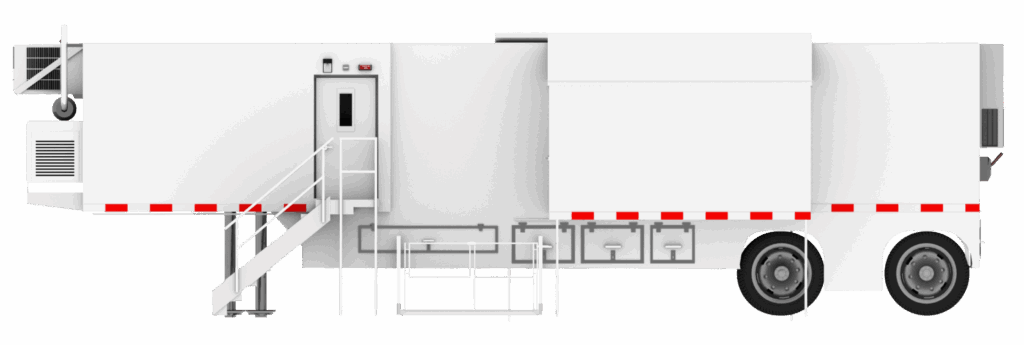
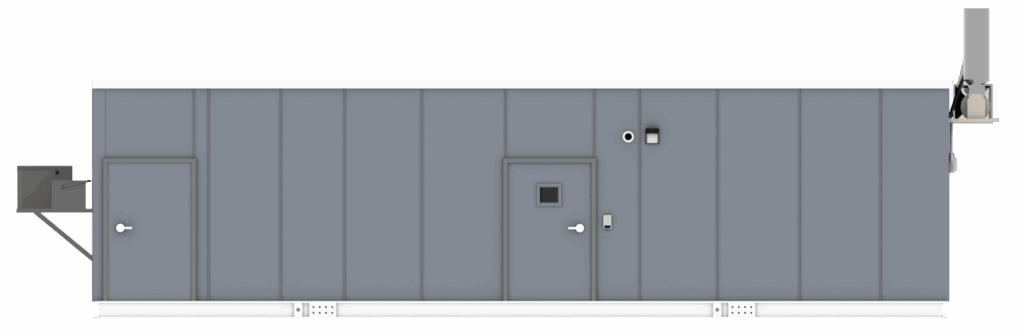
Modular Devices is rewriting the story on radiopharmaceutical manufacturing by delivering the production space where you need it, when you need it. Optimized for on-site, small-batch production, our indoor and outdoor USP <825> cleanrooms offer the turnkey clean space your team requires to safely and efficiently serve your patients.
Interested in learning more? See how you can put Modular Devices to work for your next radiopharma project.