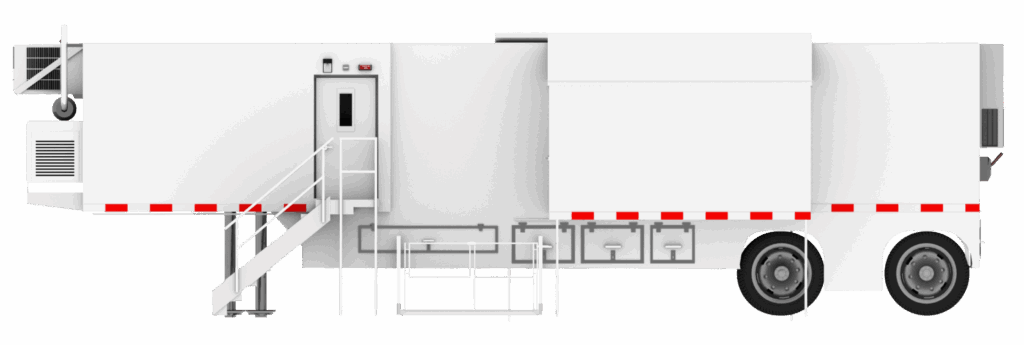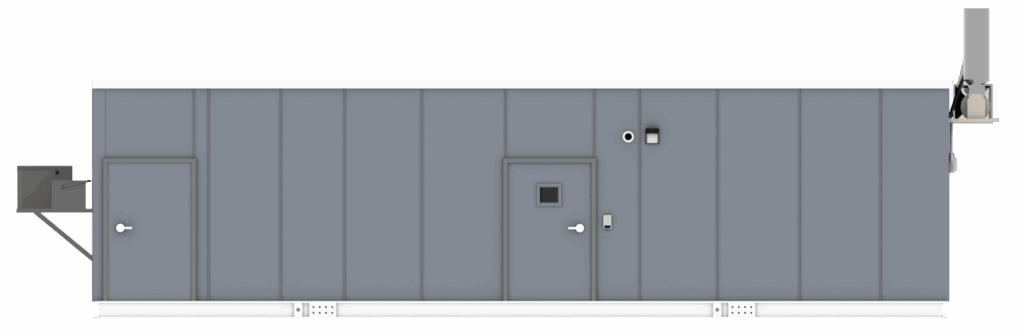
Healthcare providers across the United States are facing two growing challenges: increasing demand for advanced diagnostic imaging and the need to improve access to care. Computed Tomography (CT) scans play a critical role in diagnosing trauma, stroke, cancer, cardiovascular disease, and many other serious conditions. For many hospitals, health systems, and outpatient facilities, mobile CT units provide a flexible solution. A mobile CT scanner can be deployed quickly to support diagnostic services, maintain imaging capacity during equipment upgrades, or expand access to care in rural and underserved communities.
While mobile CT technology is designed for flexibility, maintaining high-quality CT imaging still requires careful planning and infrastructure support. Site preparation, electrical supply, environmental stability, patient workflow, and data connectivity all play a role in ensuring that a mobile CT unit operates safely and delivers reliable diagnostic results.
This guide outlines the essential infrastructure requirements for mobile CT imaging and explores how mobile CT units and modular imaging devices help healthcare providers expand diagnostic services while improving access to care.
The Role of Mobile CT in Expanding Access to Care
Access to advanced imaging remains uneven across many regions. Rural hospitals, community health centers, and growing metropolitan systems often face challenges such as equipment, capital budget constraints, limited construction space, and long timelines for installing new imaging suites.
Mobile CT scanners help close these gaps in access to care by allowing healthcare organizations to deploy diagnostic imaging where and when it’s needed the most.
Hospitals commonly use mobile CT units to:
- Maintain imaging capacity during facility renovations or equipment replacement and downtime
- Expanding access in rural or underserved communities
- Provide diagnostic support during time of emergency or catastrophe
- Reduce patient wait times
- Temporarily increase imaging capacity during periods of high patient volume
Mobile CT units can be installed and operational within days, providing hospitals with rapid delivery of critical imaging services without the delay of permanent construction.
Site Preparation for Mobile CT Units
While mobile CT units can be deployed to a wide variety of environments, the physical site for installation must meet precise requirements in order to support safe and effective patient care.
Parking and Structural Requirements
Mobile CT units are housed in specialized imaging trailers designed to protect sensitive medical equipment and provide a controlled environment for testing. The trailer must be positioned on a surface that safely supports its weight and remains stable throughout operation.
Healthcare facilities should ensure the site provides:
- A level parking surface
- Adequate clearance for positioning, leveling, and servicing the unit
- The required power and IT connections that will be reviewed by your Sales Specialist.
Hospitals often place mobile CT units adjacent to imaging departments or near emergency departments to minimize the distance that patients must travel for diagnostics. Proper site placements help integrate the mobile CT scanner into the hospital’s existing workflow.
Patient Access and Workflow Design
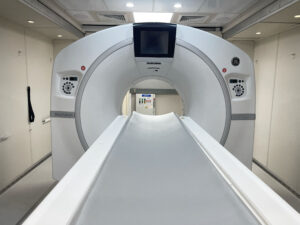 Improving access to care is not only about deploying imaging equipment. It also involved ensuring patients and staff can easily and safely reach those services. Facilities planning for mobile CT deployment should consider how patients will move between the main building and the imaging unit.
Important factors include:
- Covered Patient Pathways
- Weather-protected walkways between the hospital and mobile CT unit help maintain patient comfort and safety, particularly for patients being transported on stretchers or in wheelchairs
- ADA-Compliant Access
- Mobile CT units must accommodate patients with mobility challenges. Entryways, ramps, and lifts should allow access for wheelchairs, stretchers, and bariatric patients.
- Efficient Patient Flow
- Facilities should design intake and scheduling processes that allow the mobile CT scanner to operate efficiently without disrupting other hospital departments.
When these workflow considerations are addressed, mobile CT units can deliver an imaging experience comparable to permanent radiology suites while offering uninterrupted access to diagnostic services.
Electrical Infrastructure Requirements
Reliable electrical power is critical in providing consistent and high-quality diagnostic images.
Most mobile CT units require:
- 480V three-phase electrical service
- Dedicated electrical connections
- Proper grounding and surge protection
- Compliance with local electrical codes and safety regulations
Before a mobile CT unit arrives onsite, facilities teams typically coordinate with the imaging provider to confirm electrical compatibility and install any required power connections.
Radiation Safety and Shielding
Radiation safety is a critical consideration for any CT imaging environment. Mobile CT units are designed with built-in radiation shielding that allows them to operate safely in many hospital locations without additional structural modifications.
However, the following considerations must be made:
- Compliance with state radiation safety regulations
- Appropriate placement relative to patient areas
- Review by radiation safety personnel, when required
Mobile CT systems are engineered to meet regulatory requirements while protecting both patients and staff during imaging procedures.
Environmental Conditions and Equipment Stability
High-performance CT Scanners rely on stable environmental conditions to maintain calibration and imaging accuracy.
Mobile CT trailers include integrated climate control systems that regulate temperature and humidity within the imaging suite, but it’s important to support proper environmental conditions around the unit.
Key considerations include:
- Adequate ventilation around the trailer
- Protection from extreme outdoor temperatures
- Stable operating conditions for sensitive imaging equipment
The Future of Mobile CT and Imaging Access
Healthcare systems are under increasing pressure to provide faster diagnoses while expanding access to advanced medical technologies. Mobile CT units offer a practical solution for addressing both challenges.
Mobile CT scanners allow healthcare organizations to adapt quickly to changing patient needs while maintaining high standards of diagnostic quality.
For hospitals and healthcare networks focused on access to care and timely diagnosis, mobile CT technology represents an important step toward delivering advanced imaging where and when patients need it the most.
Supporting Mobile CT Deployment with Modular Devices Imaging
At Modular Devices, we partner with best-in-class OEMs and healthcare providers nationwide to ensure that mobile CT deployments meet all infrastructure, operational, and regulatory requirements necessary for high-quality imaging. From early site planning to workflow integration and connectivity, our team works alongside hospital leadership, facilities teams, and clinical staff to help ensure a smooth and successful deployment.
Our imaging solutions are designed to expand access to care while maintaining the diagnostic standards healthcare providers expect. With deployments in 49 of the 50 states, Modular Devices has helped hospital, health systems, and outpatient facilities across the country provide care to the patients who need it the most.